| Light | Bright, indirect light; shade to dappled sun outdoors |
|---|---|
| Water | Keep evenly moist — water when the top inch starts to dry |
| Humidity | 50%+ (they love Hawaii's humid air) |
| Soil | Rich, peat-based mix with good drainage |
| Feeding | Diluted balanced liquid fertilizer monthly, spring–fall |
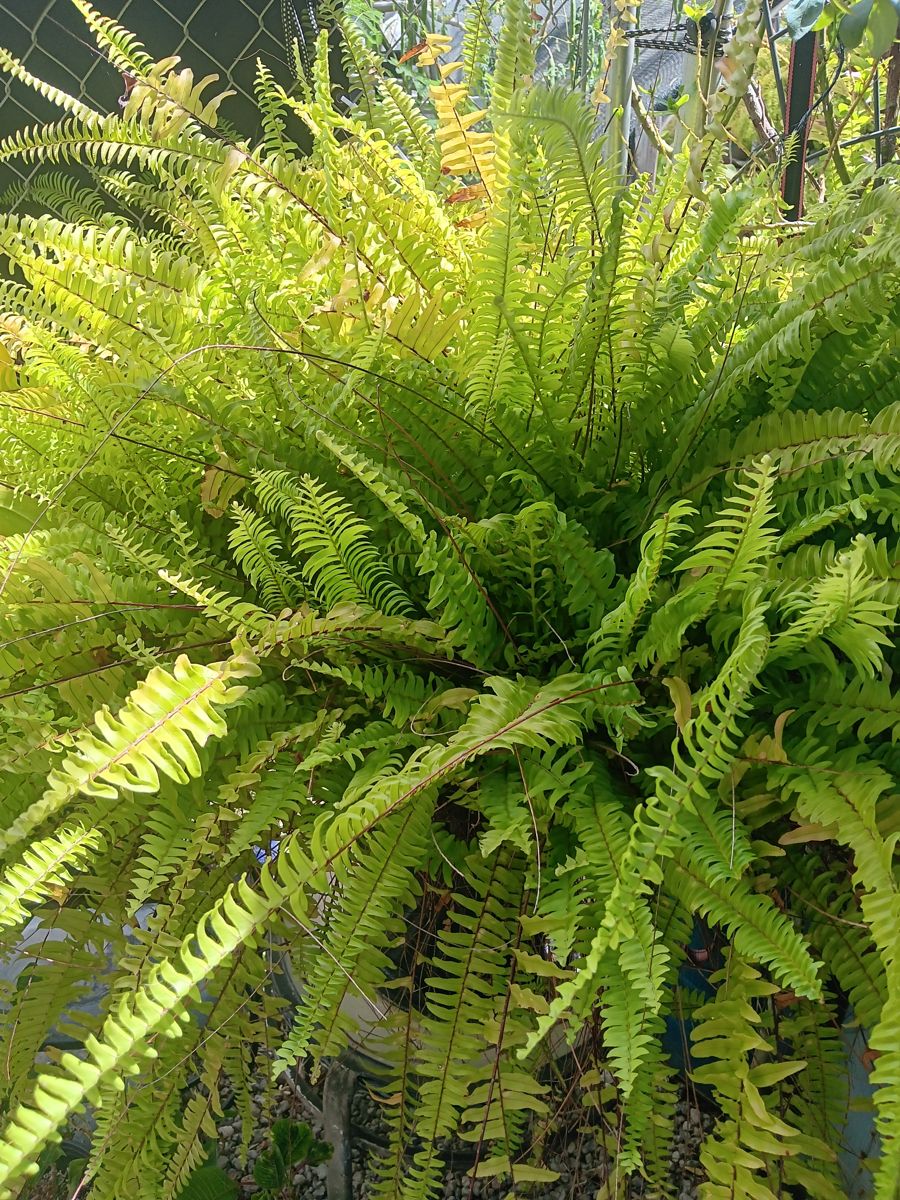
| Size | 2–3 ft fronds in a happy hanging basket |
| Pets | Non-toxic to cats and dogs (ASPCA) |
| Best spot in Hawaii | Covered lanai, porch, or under a shade tree |
📄 Take this guide with you
Get the free printable Boston Fern Care Card — a one-page cheat sheet for the fridge, the greenhouse, or the plant shelf. Pop in your email and it's yours.
Mahalo! Here's your card: Download the Boston Fern Care Card (PDF) →
We'll also send the occasional nursery update — what's blooming, what's ready for pickup. No spam, unsubscribe anytime.
How much light does a Boston fern need?
Boston ferns want bright, indirect light — think of the dappled shade under a tree canopy, which is where wild ferns grow. Indoors, a spot near an east-facing window is ideal. Outdoors in Hawaii, a covered lanai or porch is perfect. Direct midday or afternoon sun scorches the fronds, bleaching them pale and crisping the tips. Deep shade works, but growth slows and the plant gets thin. If your fern is pale yellow-green all over, it may be getting too much sun; if it's dark but sparse, give it more light.
How often should I water a Boston fern?
Water a Boston fern when the top inch of soil starts to dry — typically 2–3 times a week for hanging baskets in warm weather, less for potted ferns in shade. The goal is soil that stays lightly moist at all times, never bone-dry and never waterlogged. Hanging baskets dry out much faster than ground pots because air circulates all around them. A dried-out fern sheds leaflets like confetti; a drowned one turns yellow and rots at the crown. When in doubt, lift the basket — a light basket means it's thirsty.
What soil and fertilizer do Boston ferns like?
Use a rich, peat-based potting mix that holds moisture but still drains freely — a standard indoor potting mix with a handful of perlite works well. Feed monthly during spring through fall with a balanced liquid fertilizer diluted to half strength. Ferns are light feeders; overfeeding burns the frond tips brown. Skip fertilizer in winter when growth slows. Repot every couple of years when roots fill the container, moving up just one pot size.
How do you propagate Boston ferns?
The easiest way to propagate a Boston fern is division: pull the plant from its pot, slice the root ball into halves or quarters with a clean knife, and pot each piece up. Each division looks rough for a few weeks, then pushes new fiddleheads. Boston ferns also send out fuzzy runners (stolons) — pin a runner into a pot of moist soil while it's still attached to the parent, and it will root and grow into a new plant. This is exactly how we grow our nursery stock, so you know it works in Hawaii conditions.
Why is my Boston fern turning brown?
Browning fronds almost always trace to one of four causes. Crispy brown tips mean dry air or missed waterings — move it somewhere more humid and water more consistently. Whole fronds yellowing then browning from the base is normal for the oldest fronds, but if it's widespread, check for soggy soil and root rot. Pale, scorched patches mean too much direct sun. And constant leaflet shedding usually means the plant went too dry at some point — trim the bald fronds at the base and new growth will fill in. Watch also for scale and mealybugs on the midribs; treat with insecticidal soap or neem oil.
Can Boston ferns grow outdoors in Hawaii?
Yes — Boston ferns grow outdoors year-round in Hawaii and get spectacular. With no winter to knock them back, a basket that would be an annual on the mainland becomes a permanent fixture here. Give them shade, moisture, and protection from strong trade winds, which shred and dry the fronds. Hawaii also has a beloved native relative, the kupukupu fern (Nephrolepis cordifolia and the native form of N. exaltata), traditionally used in hula. Boston ferns are non-invasive in a basket, easy to share, and non-toxic to pets — one of the friendliest plants we grow.
Boston Fern FAQ
Are Boston ferns safe for cats and dogs?
Yes. Boston ferns are non-toxic to both cats and dogs according to the ASPCA, making them one of the safest lush houseplants for homes with pets.
Should I mist my Boston fern?
Misting gives only a brief humidity boost. In Hawaii's naturally humid air it's usually unnecessary. In dry rooms (or air-conditioned spaces), grouping plants together or using a pebble tray works better than misting.
Why is my Boston fern dropping leaves everywhere?
Leaflet shedding is the classic sign the fern went too dry — either the soil dried out completely or it's sitting in hot, dry moving air. Water consistently and move it out of wind or AC drafts.
How big do Boston ferns get?
A happy Boston fern in a hanging basket typically reaches 2–3 feet across, with fronds arching down dramatically. In the ground in shade they can spread wider via runners.
🧰 Our favorite boston fern tools & supplies
What we actually reach for at the nursery:
- Coco-lined hanging baskets (12–14") — the liner breathes and keeps roots cool — what we use at the nursery
- Balanced liquid fertilizer (e.g., 20-20-20) — dilute to half strength, monthly in the growing season
- Long-spout watering can — reaches hanging baskets without soaking the porch
- Neem oil or insecticidal soap — the safe fix for scale and mealybugs
- Soil moisture meter — takes the guessing out of 'is it dry an inch down?'
Heads up: some links on this page may become affiliate links, which means we may earn a small commission (at no extra cost to you) if you buy through them. We only recommend things we actually use in our own backyard.
Sources & further reading: ASPCA plant toxicity database and University of Hawaiʻi CTAHR extension publications on fern culture. Everything else comes from our own hands-on growing in Wai'anae, O'ahu.